

游戏清单下载
请选择以下任意链接下载游戏清单文件,下载后请参考安装教程进行配置
游戏介绍
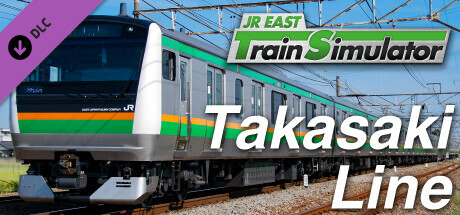
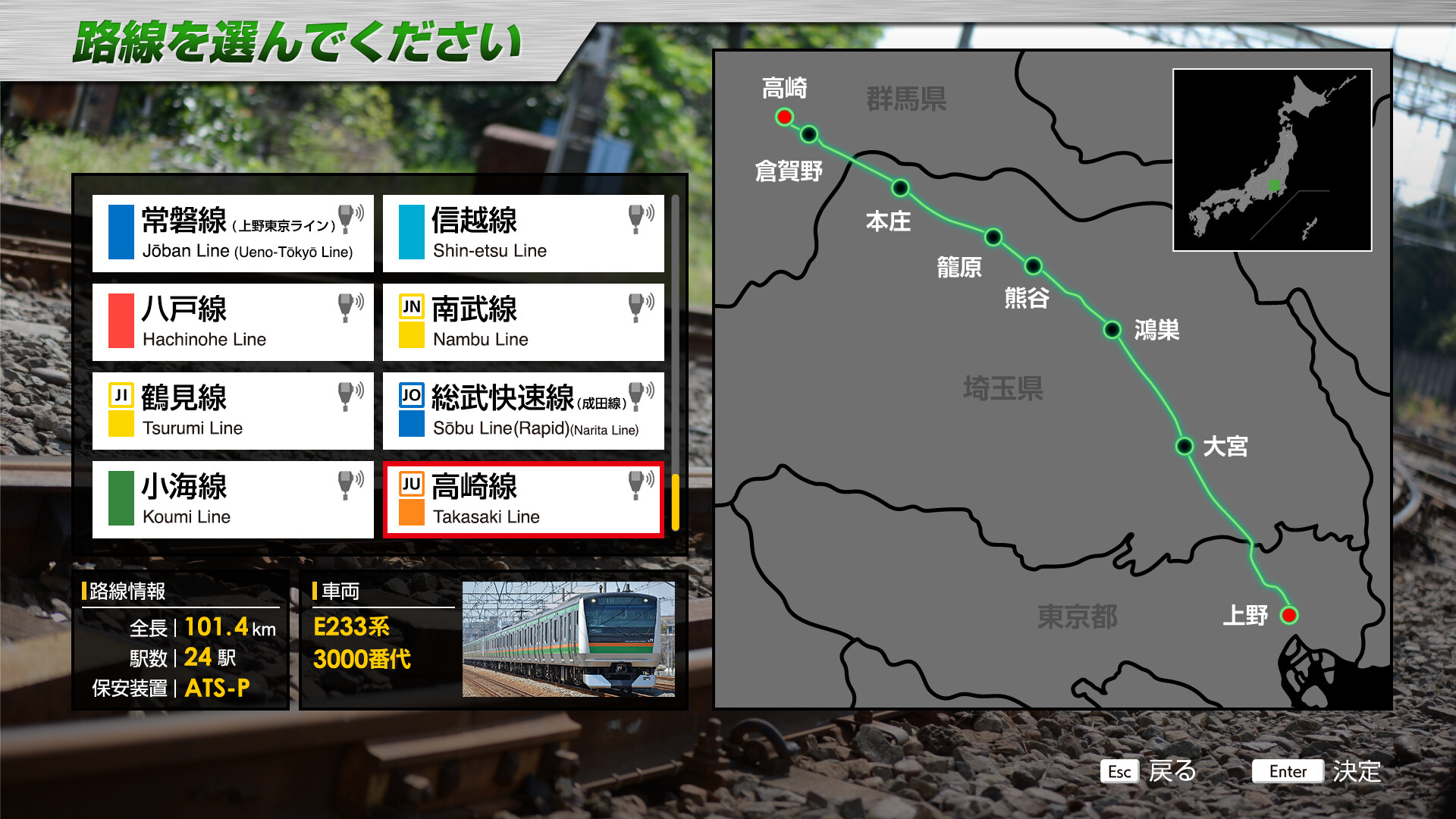
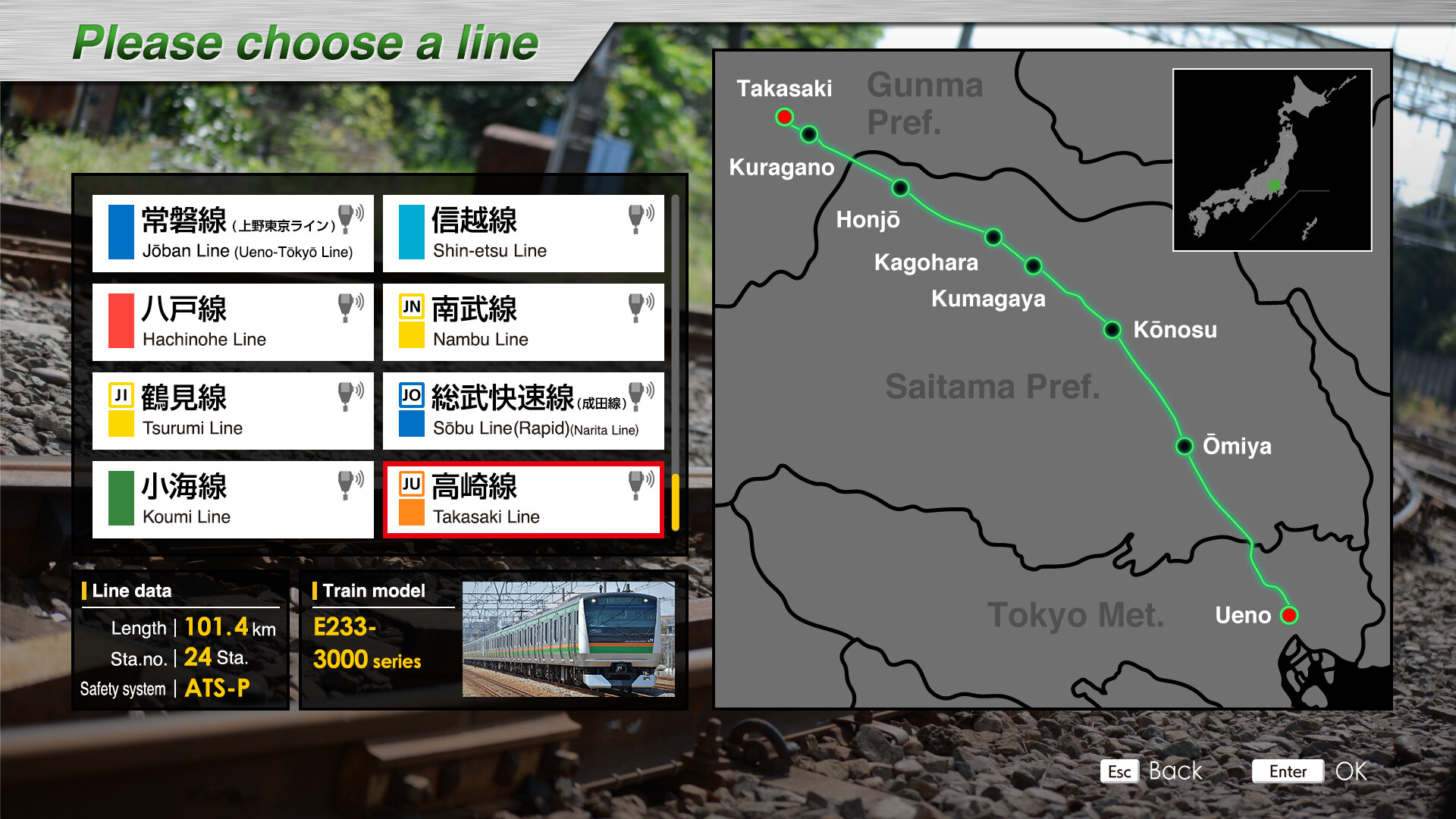
The Takasaki Line is a 74.7 km long line connecting Omiya Station in Saitama City, Saitama Prefecture to Takasaki Station in Takasaki City, Gunma Prefecture. This DLC includes the Tohoku Main Line section between Ueno and Omiya stations, for a total length of 101.4 km.
The line has a relatively long history among Japanese railroads, with its predecessor, Nippon Railway Company, starting operations between Ueno Station and Kumagaya Station in 1883. The following year, in 1884, the line was extended to Takasaki Station and opened to full service. It was not until later, in 1909, that the line was officially named the "Takasaki Line".
Until the opening of the Joetsu Shinkansen in 1982, the Takasaki Line was the main transportation link between the Tokyo metropolitan area and the Niigata and Hokuriku regions, with many limited express and sleeper trains operating on the line. Currently, most of the long-distance transportation role has been handed over to the parallel Joetsu Shinkansen, and as of 2024, only "Akagi Limited Express" and "Kusatsu-Shima Limited Express" trains regularly operate on the Takasaki Line as limited express trains.
The Takasaki Line has been used as a key interregional transportation line for commuting to work and school, etc. In 2001, the Shonan-Shinjuku Line started service directly to the Tokaido Line via Ikebukuro and Shinjuku Stations, and in 2015, the Ueno-Tokyo Line started service directly to the Tokaido Line via Tokyo and Shinagawa Stations, allowing passengers to travel between the northern Kanto region and Kanagawa Prefecture without changing trains. The new line allows passengers to travel between northern Kanto and Kanagawa Prefecture without having to change trains.
On the way from Ueno Station to Omiya Station, the line runs parallel to the Keihin-Tohoku Line and the Shonan-Shinjuku Line, and continues through the Tokyo bedroom community. After leaving Omiya Station, fields along the line become conspicuous near Konosu Station, and near Fukaya Station, you can see the fields of "Fukaya Negi" green onions, which are famous throughout Japan. We hope you will enjoy this DLC as you ride along the Takasaki Line at speeds of up to 110 km/h while gazing at the ever-changing scenery.
Highlights
-
Horizon Platform/Ueno Station
It is the gateway to the northern area. Cars depart from the level platform where sleeper express trains used to arrive and depart. -
Arakawa Bridge/Akabane Station – Kawaguchi Station
The bridge carries the Keihin-Tohoku Line, Tohoku Line, and Tohoku Freight Line. -
Saitama Rolling Stock Center/Kawaguchi Station – Urawa Station
The Keihin-Tohoku Line rail yard can be seen on the right side in the direction of travel. -
Omiya marshalling yard/Urawa Station~Saitama-shintoshin Station
You can see many detention lines. -
Intricate turnout rail/Saitama-Shintoshin Station – Omiya Station
The turnouts for the Tohoku Line and the Takasaki Line can be seen in confusion. -
Omiya General Rolling Stock Center/Omiya Station – Miyahara Station
The Omiya General Rolling Stock Center, which performs maintenance on trains in the Tokyo metropolitan area, can be seen on the left side of the train in the direction of travel. -
Intersection with Chichibu Railway / Gyoda Station – Kumagaya Station
-
Section running parallel to Chichibu Railway/Kumagaya Station – Kumagaya Freight Terminal Station
The Chichibu Railway tracks can be seen on the left in the direction of travel, running parallel to each other. -
The vast freight yard / Kumagaya Station – Kumagaya Freight Terminal Station
Ahead of you, you will see a vast freight yard stretching across the Takasaki Line’s down line. -
Kagohara Depot, Takasaki Rolling Stock Center/Kagohara Station – Fukaya Station
The group of detention lines at the Kagohara Depot of the Takasaki Rolling Stock Center comes into view. -
Fukaya Station Building/Fukaya Station
Since Tokyo Station uses a large amount of bricks produced at the Fukaya factory, the station building was modeled after Tokyo Station when it was reconstructed. Shibusawa Eiichi, whose portrait will appear on the new 10,000 yen bill, was born in Fukaya. -
Giant Substation / Okabe Station – Honjo Station
A huge facility made of a large number of steel frames suddenly appears on the right. It is the new Okabe substation of Tokyo Electric Power Grid Co. The Takasaki Line runs through the side of the substation. -
Minare River Bridge/Okabe Station – Honjo Station
This is one of the best photo spots on the Takasaki Line. -
Kanna River Bridge/Jinbohara Station – Shinmachi Station
-
Merge with the Hachiko Line/Kita-Fujioka Station -Kuragano Station
The train merges with the Hachiko Line coming from the direction of Komagawa. -
Takasaki marshalling yard/Kuragano Station – Takasaki marshalling yard Station
This yard was once a bustling freight train yard. -
JR Freight’s Takasaki Engine Depot and JR East’s Gunma Rolling Stock Center/Kuragano Station – Takasaki Station
As Takasaki Station approaches, JR Freight’s Takasaki Engine Works and JR East’s Gunma Rolling Stock Center can be seen on the right, and just before arrival, the Takasaki Station detention line on the right and Jyoshin Electric Railway on the left.
Inside Takasaki Station, Series 211 Shonan color trains and Series 700 trains (former JR107 series) working for Jyoshin Electric Railway can be seen. Near the actual Takasaki Station, you may see an SL if you are lucky.
Train Line Information
-
Karasawa River Cherry Blossom Bank/Fukaya Station
In spring, the rows of cherry trees along the Karasawa River and Takinomiya Shrine near Fukaya Station are at their best. The cherry blossoms are illuminated at night and are also beautiful. -
Mt. Fuji from the train window / Akabane Station to Urawa Station, Gyoda Station to Kumagaya Station, and many others
There are many spots along the Takasaki Line where you can view Mt. Fuji, especially on a clear winter day. -
Lots of delicious food/Jimbobara Station – Shinmachi Station – Kurgano Station
There are many factories along the Takasaki Line, but this area in particular is dotted with food-related factories such as confectionery, ice cream and bakery factories. When you get off the train, you may smell sweet smells wafting through the air. -
Hina Doll Production Area/Konosu Station
Konosu is a town of dolls with a history of about 400 years, and in February and March, the city holds an event to display the tallest pyramid hina-dan in Japan in the city. -
Konosu Fireworks Display/Konosu Station
The fireworks display held in the fall also launches a 4-foot fireworks ball, creating a large bloom in the night sky.
Route Information
-
Section: Takasaki Line Outbound Ueno(Horizon platform) ⇒ Takasaki
-
Total length: 101.4 km
-
Number of Stations: 24
-
Security equipment: ATS-P
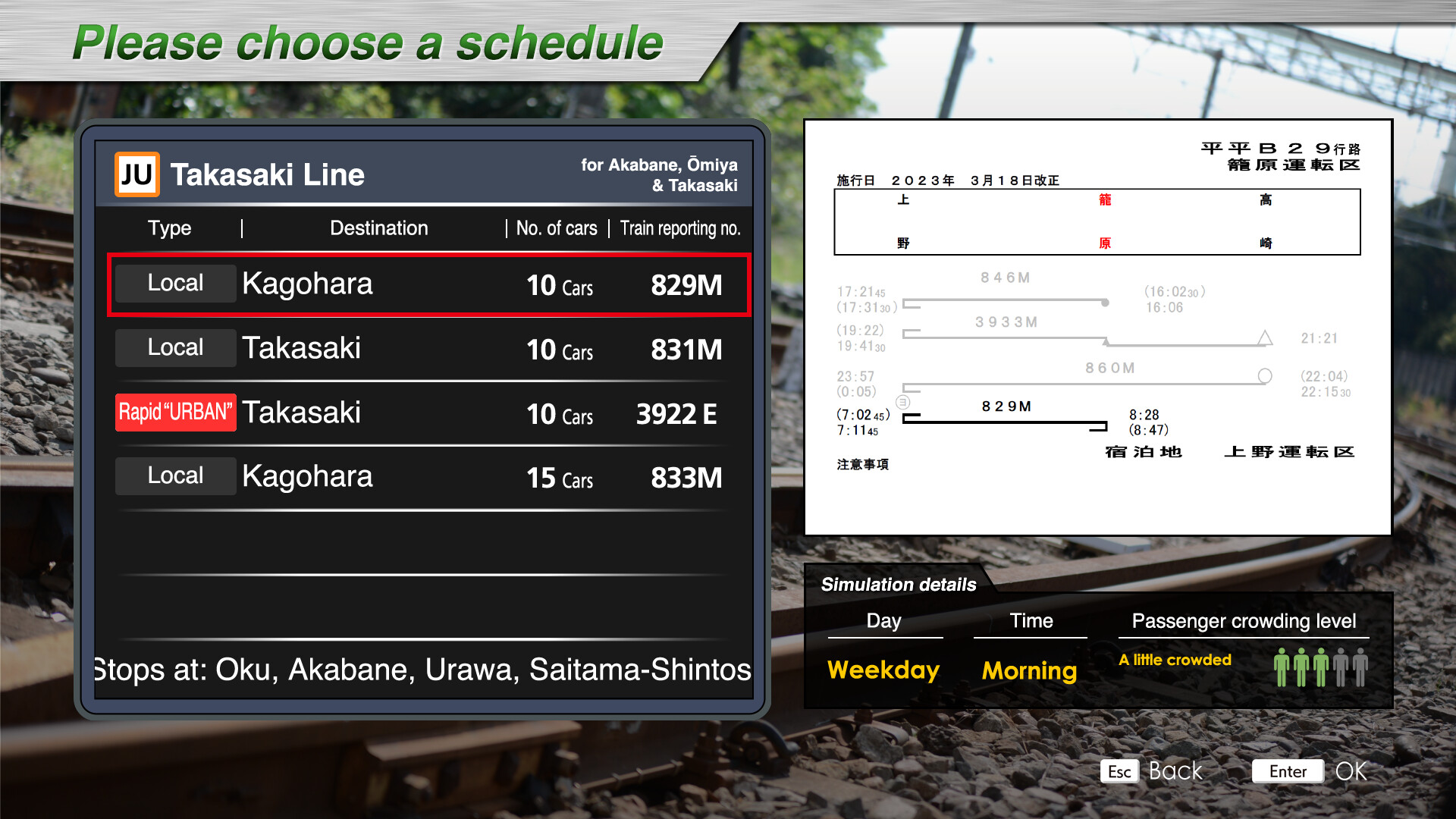
Train schedules that can be operated
-
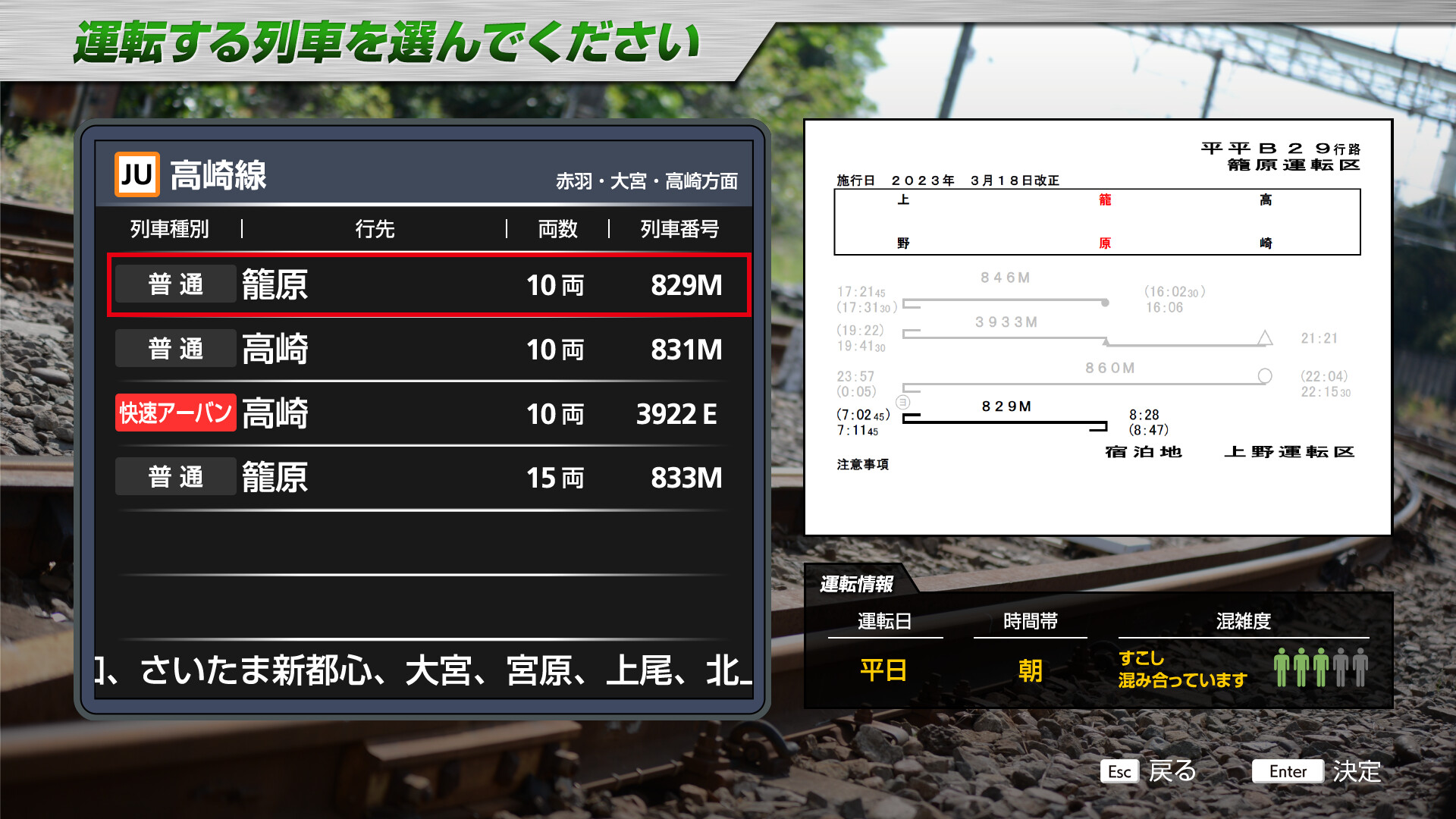
Train Number:829M
-
Type/Destination: Local train to Kagohara
-
Section where you can drive: Ueno(07:11)→Kagohara(08:28)
-
Type of train: Series E233-3000 10 cars
-
Responsible for real voice train announcements: Kagohara train crew depot
-
Train Number:831M
-
Type/Destination: Local train to Takasaki
-
Section where you can drive: Ueno(07:32)→Takasaki(09:20)
-
Type of train: Series E233-3000 10 cars
-
Responsible for real voice train announcements: Kagohara train crew depot
-
Train Number:3922E
-
Type/Destination: Rapid train "Urban" to Takasaki
-
Section where you can drive: Ueno(09:29)→Takasaki(11:05)
-
Type of train: Series E233-3000 10 cars
-
Responsible for real voice train announcements: Kagohara train crew depot
-
Train Number:833M
-
Type/Destination: Local train to Kagohara
-
Section where you can drive: Ueno(10:30)→Kagohara(11:42)
-
Type of train: Series E233-3000 15 cars
-
Responsible for real voice train announcements: Kumagaya unification center
系统要求
最低配置:
最低配置:
- 需要 64 位处理器和操作系统
- 操作系统: 64-bit Windows 11
- 处理器: Intel Core i5-8500 or AMD Ryzen 5 2600
- 内存: 16 GB RAM
- 显卡: NVIDIA GeForce GTX 1060 (VRAM 6GB)
- DirectX 版本: 12
- 存储空间: 需要 25 GB 可用空间
- 附注事项: need resolution 1920×1080@60Hz
推荐配置:
推荐配置:
- 需要 64 位处理器和操作系统
- 操作系统: 64-bit Windows 11
- 处理器: Intel Core i5 12400 or AMD Ryzen 5 5500
- 内存: 16 GB RAM
- 显卡: NVIDIA GeForce RTX 3060 (VRAM 8GB)
- DirectX 版本: 12
- 存储空间: 需要 25 GB 可用空间
- 附注事项: Recommended SSD
游戏截图
游戏共有 6 张截图,这里显示了 4 张